
Published · Updated
The short answer
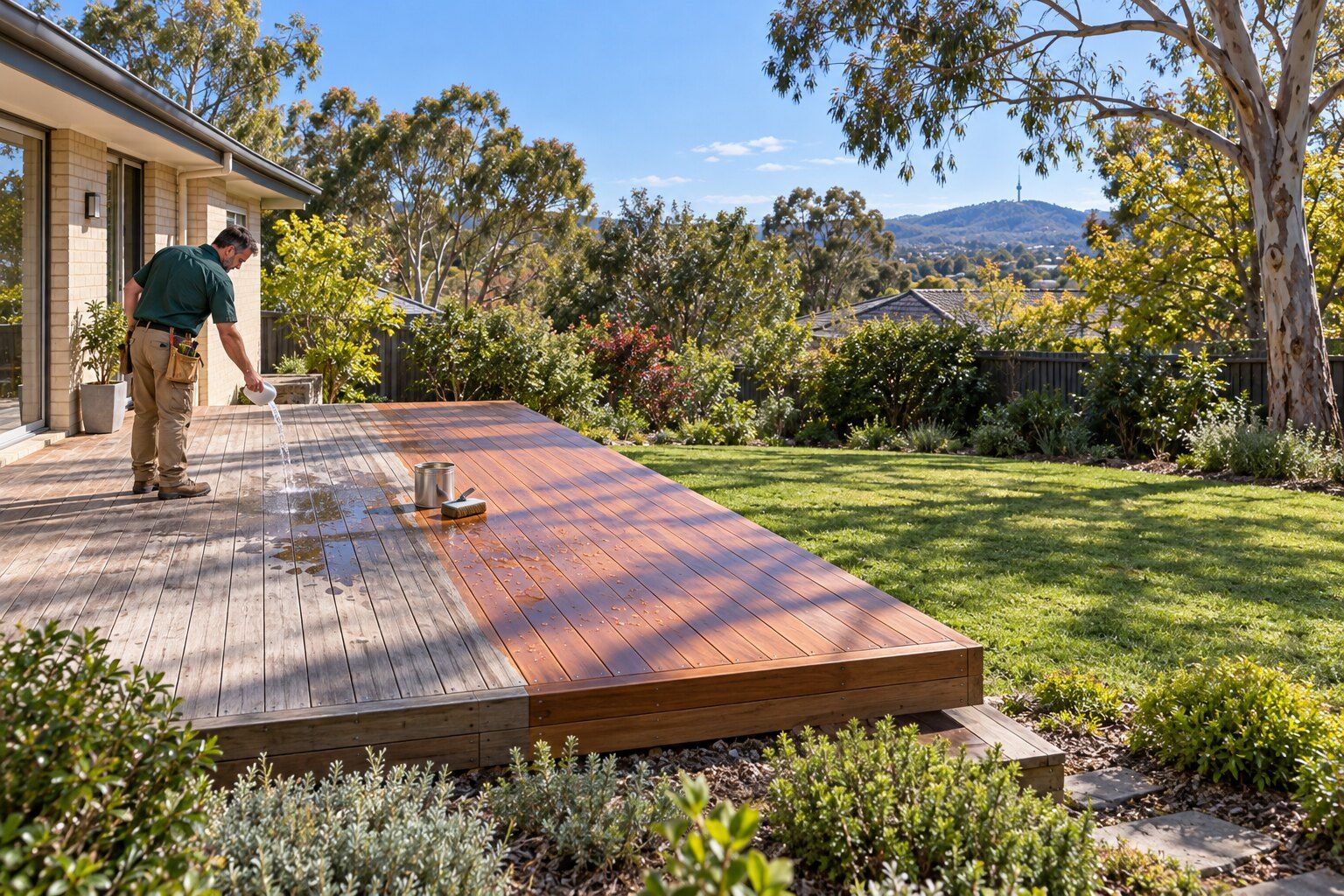
Most decking oil makers say to inspect the finish every 12 months and re-oil when water stops beading or the colour fades, rather than on a fixed date. A north-facing deck in full Canberra sun is usually due sooner than one under a pergola. Oil in dry, mild weather: Cabot's says not below 10 °C or above 35 °C for its natural decking oil, and Intergrain allows 5 °C to 35 °C for UltraDeck (checked 12 October 2026). Grey, rough or cracked boards need sanding before the oil goes on.
How often to oil a deck in Canberra
There isn't one right interval. Cabot's tells owners to "inspect your coated timber for changes in colour or water repellency" every 12 months and recoat when needed; Intergrain recommends a routine 12-monthly inspection and recoating before the coating and the timber underneath deteriorate.
In Canberra, three things decide how quickly a deck gets there:
- Sun. The ACT climate guide from the Bureau of Meteorology and CSIRO reports an average of seven days a year above 35 °C (1989 to 2018). An unshaded north or west-facing deck dries and fades fastest.
- Frost and dew. Boards that stay wet on winter mornings, especially low decks near the lawn, lose their finish faster at the ends and edges.
- Foot traffic. The path from the back door to the steps wears through first. Oiling just the worn areas rarely blends in, so it's usually the whole deck.
The simple test: sprinkle water on the boards. If it beads, the oil is still working. If it soaks in and darkens the timber, the deck is due.
The best time of year to oil
Oil needs dry timber, mild temperatures and no rain while it dries. Cabot's says not to apply its natural decking oil below 10 °C or above 35 °C, to avoid direct sun in hot weather, and to avoid days when rain or heavy dew is expected during drying. Intergrain's UltraDeck can go on between 5 °C and 35 °C, but in cool conditions (5 to 15 °C) it needs 8 hours between coats and 48 hours before you walk on it, against 3 hours and a full day in ideal conditions.
That's why spring and autumn suit Canberra best. Winter mornings are often too cold and the boards too damp from frost and dew until late in the day, and summer afternoons can push past 35 °C on the boards. The climate guide notes that Canberra's frost risk has typically ended by the last week of October, so late spring and early autumn give the longest workable days.
Oiling a new deck
New hardwood, and merbau in particular, is full of natural tannins and oils that stop a coating soaking in. Cabot's says its new timber prep product lets you skip "the 4-6 weeks weathering process required for new timber"; without a prep product, that weathering period is the usual wait. Intergrain's instructions are to treat new timber with a tannin and oil remover, then clean it, before the first coat.
Both makers specify two coats as the starting point, and Intergrain says a third "is required in harsh conditions". On a new deck, the first oiling sets up how well it lasts, so it's worth doing properly rather than straight after the last screw goes in. Our decking timber guide covers how merbau, spotted gum and composite differ.
When a deck needs sanding first
Oil sits on what's there. If the boards are grey and furry, the oil soaks unevenly and the grey shows through. Sanding takes the weathered surface back to fresh timber so the new oil can soak in evenly. Intergrain's own instruction for severely weathered timber is to sand back to a fresh surface and remove the dust before cleaning.
Clean and re-oil
The boards still have colour, water has just stopped beading, and there's no flaking film. A deck clean and a fresh coat or two is usually enough.
Sand and oil
The timber has gone silver, feels rough or has fine surface cracks, or a previous coating is patchy. The deck needs sanding back before oiling.
Repair, then sand and oil
Some boards are split, cupped or soft, nails have lifted, or the steps move. Those get fixed first, otherwise the sander catches on raised fixings and the new boards miss the first coat.
Repairs to do before oiling
- Punch down or replace raised nails, ideally swapping them for decking screws
- Replace split, cupped or soft boards with the same width and thickness
- Tighten or rebuild loose steps and landings
- Check underneath: a deck that bounces or leans has a frame problem
Frame repairs are structural
Replacing rotten bearers, joists or posts that carry the deck is a structural repair that needs a licensed ACT builder. Boards, fixings, steps, sanding and oiling are the maintenance work we do. See our deck repairs page.
Doing it yourself, or getting it done
Re-oiling a sound deck that's still in good condition is a reasonable weekend job: clean, let it dry, two coats, and keep everyone off it until the maker's walk-on time has passed. Sanding a whole deck, replacing boards and sorting raised fixings is where most people call a carpenter, mainly because of the time and the hire sander.
If the house was built before 2003 and the deck butts against old fibre-cement sheeting at the base of the wall, don't sand or scrape that sheeting. WorkSafe ACT says pre-2003 properties must be assumed to contain asbestos; see the asbestos guide.
Questions about deck oiling
How often should I oil my deck in Canberra?
Check it every 12 months, as the oil makers recommend, and re-oil when water stops beading or the colour fades. An unshaded north-facing deck is usually due sooner than one under shade.
Can I oil a deck in winter?
Only on a dry, mild day. Some oils can't be applied below 10 °C, and frost or dew on the boards stops oil soaking in. Spring and autumn are more reliable in Canberra.
How long should a new deck weather before oiling?
Cabot's mentions a 4 to 6 week weathering period for new timber, which its prep product is designed to skip. Follow the instructions for the oil you'll use.
How long after oiling can I walk on the deck?
It depends on the oil and the weather. Intergrain's UltraDeck, for instance, says a full day in ideal conditions and 48 hours in cool conditions.
Do I need to sand the deck every time?
No. A deck that's re-oiled before it turns grey usually needs only a clean. Sanding is for weathered, rough or patchy boards.
Where these figures come from
The prices and rules on this page come from these published pages, checked on 12 October 2026.
- Cabot's Natural Decking Oil: product page · Decking oil manufacturer's instructions (maintenance, new timber, temperatures)
- Intergrain UltraDeck Timber Oil: product page · Decking oil manufacturer's instructions (maintenance, temperatures, drying times)
- Bureau of Meteorology and CSIRO: ACT climate guide · Australian Government climate guide for Canberra, 2019 (frost season and days over 35 °C, 1989–2018)
- WorkSafe ACT: identify and remove asbestos before residential renovations · WorkSafe ACT safety alert, 16 January 2025