
Published · Updated
The short answer
Neighbours usually share the cost of a dividing fence. Under the ACT's Common Boundaries Act 1981, if you can't agree, either of you can apply to ACAT, but only after giving written notice asking to discuss it and waiting 30 days. If one neighbour asks for a basic fence, ACAT can't make the other pay more than half its cost. The Act's basic urban fence is a 1.5 m timber paling fence on precast concrete posts. Fences next to Territory land, such as a park or laneway, are built at your own cost (checked 12 October 2026). This is general information, not legal advice.
The ACT's basic urban fence
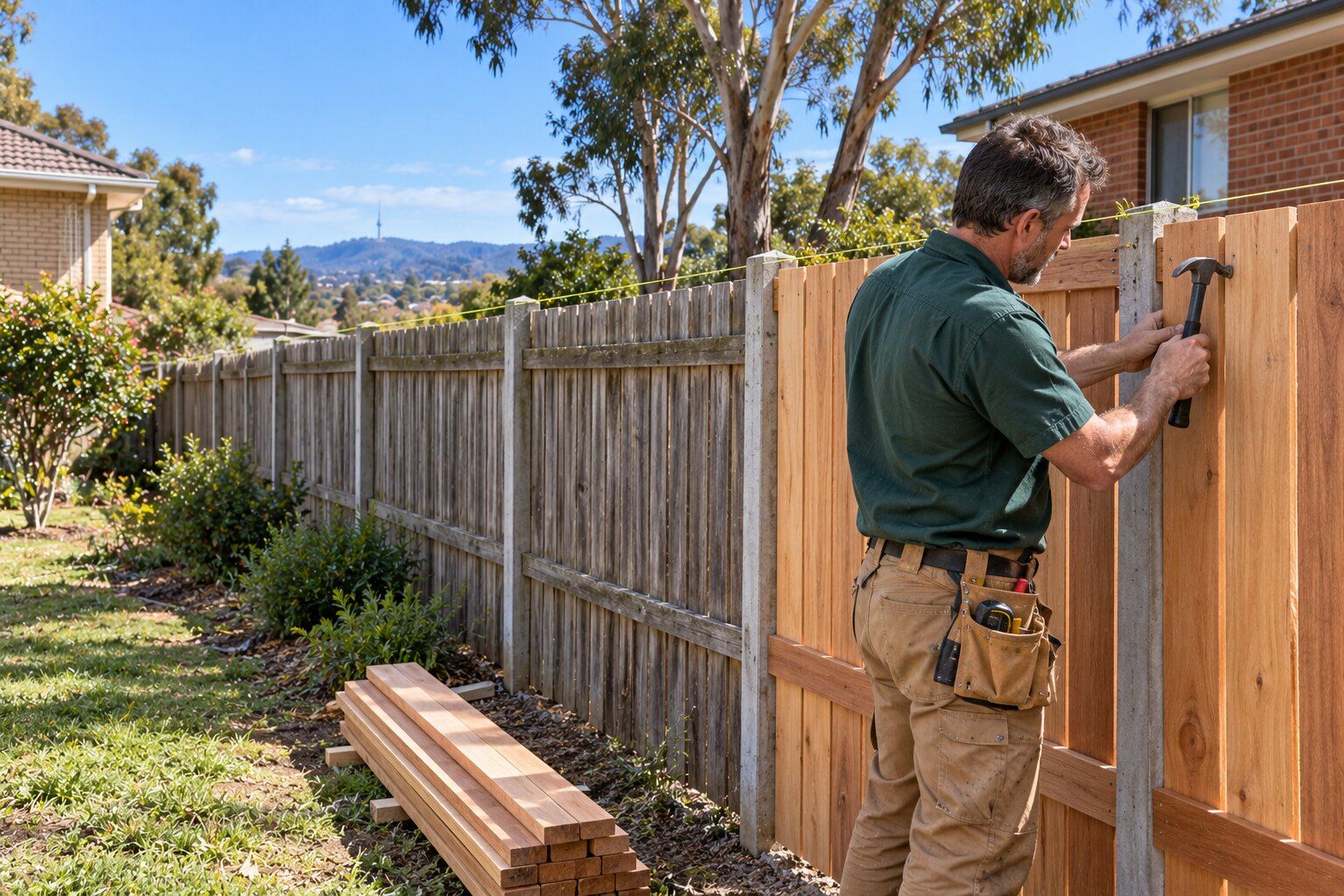
The Common Boundaries Act sets a benchmark fence for blocks in the city area, called a basic urban fence. Section 2 defines it as a timber paling fence 1.5 m high above finished ground level, with:
- reinforced spade-end precast concrete posts spaced at 2.4 m
- a 75 mm × 50 mm hardwood rail at the top and bottom, fixed to the posts
- 100 mm × 12 mm hardwood palings nailed to the rails
It's a benchmark for sharing costs, not a required design. You and your neighbour are free to agree on something else: a higher fence, timber posts, a lapped and capped paling fence or a steel fence. The basic fence only matters if you can't agree and the question of cost goes to ACAT.
Who pays for a dividing fence
The Environmental Defenders Office's ACT fact sheet puts it simply: private owners are "each responsible for half the cost and maintenance of a basic urban fence". If you want something better than the basic fence, agree the design and cost with your neighbour before it's built; the EDO notes those costs can include removing the old fence and a surveyor.
In the Act itself, when ACAT decides a new-fence application it sets how much the other party contributes. If a party has asked for a basic fence, ACAT must not require them to contribute more than half the cost of a basic fence (s 10(3)), unless a basic fence is impracticable or there are special circumstances. For repairs, the Act's starting point is equal shares.
Notices, mediation and ACAT
Most fences are sorted out over the back fence. If yours isn't, the Act sets the steps:
New fence or replacement
Give your neighbour written notice asking them to discuss building and paying for the fence. You can apply to ACAT for a new fence determination once 30 days have passed (s 4).
Repairs
The same: written notice asking to discuss repairing or replacing the fence, then 30 days (s 5).
Repairs already done
If one neighbour has repaired the fence and wants a contribution, the notice asks to discuss the cost and the wait is 14 days. The Act allows urgent repairs without notice first (s 6).
The EDO fact sheet suggests mediation through the ACT's Conflict Resolution Service before ACAT. ACAT applications use a fence dispute form and carry a fee. Keep copies of your notices, any quotes and photos of the fence.
Fences next to parks, reserves and laneways
Where your block backs onto unleased Territory land, such as a park, nature reserve or laneway, there's no neighbour to share with. The EDO fact sheet says those fences "are built and maintained at your own cost", that materials may be restricted, and that the government can require you to build a fence on the boundary at your own expense (s 23).
If you back onto bushland, ask before choosing materials, and remember the Act's fire rule: if a neighbour clears flammable material for 6 m from a fence and the other occupier doesn't, the non-clearer pays to repair fire damage to the dividing fence (s 26A).
Timber fence styles: paling, lapped and capped, and slatted
Plain paling fence
Palings butted side by side on two rails, the basic urban fence. Cheapest to build and repair, but gaps open up as palings shrink.
Lapped and capped
Palings overlap each other for privacy, with a capping rail along the top to shed water. Looks neater and lasts longer at the top edge.
Slatted or batten screen
Horizontal or vertical battens with even gaps, often in hardwood. A modern look for a side or front fence, with less privacy than palings.
Posts
Concrete posts outlast timber in the ground. Timber posts in the ground need H4-treated pine or a durable hardwood. Rot and termites at ground level are the usual reasons old fences lean.
Height and approval
A timber fence up to 1.8 m is exempt from building approval in the ACT. For the planning exemption, fence panels can be no higher than 2.3 m and posts no higher than 2.5 m, and the exemption doesn't cover fences between the front boundary and the building line. Front fences need their own check. Our fences and gates page covers the work we do; if your street is in a heritage precinct, our Inner North page explains the fence rules there.
Pool fences are different
If the dividing fence is part of a regulated swimming pool's safety barrier, the Common Boundaries Regulation 2024 sets matters ACAT must consider, and ACT Planning has guidance on upgrading a shared boundary fence under the pool safety reforms. Pool fencing is outside our scope.
Questions about dividing fences
Do I have to pay half of my neighbour's new fence in the ACT?
Usually neighbours share the cost of a basic urban fence. If you can't agree and it goes to ACAT, and you've asked for a basic fence, ACAT can't make you contribute more than half the cost of a basic fence, except in special circumstances.
How much notice do I give my neighbour?
Give written notice asking to discuss the fence, then wait 30 days before applying to ACAT for a new fence or repair. For a contribution to repairs already done, it's 14 days.
Can my neighbour replace the fence without asking me?
They can build at their own cost, but if they want you to contribute, the Act expects written notice and a chance to discuss it first, except for urgent repairs.
Who pays for a fence next to a park or laneway?
You do. Fences next to unleased Territory land are built and maintained at the owner's cost, and materials may be restricted.
What is a basic urban fence?
The Act's benchmark: a 1.5 m timber paling fence on reinforced precast concrete posts at 2.4 m, with hardwood rails top and bottom and 100 × 12 mm hardwood palings.
Where these figures come from
The prices and rules on this page come from these published pages, checked on 12 October 2026.
- Common Boundaries Act 1981 (ACT) · ACT Legislation Register, republication 23 effective 6 December 2025
- Environmental Defenders Office: common boundaries and fences in the ACT · Community legal centre fact sheet (law stated as at January 2019; page modified March 2022)
- ACT Planning: making upgrades to a shared boundary fence (pool safety reforms) · Territory Planning Authority, boundary fences that form part of a pool barrier
- Planning (Exempt Development) Regulation 2023 · ACT Legislation Register, republication effective 22 May 2026
- Building (General) Regulation 2008 · ACT Legislation Register, republication effective 1 October 2026 (schedule 1, exempt building work)
- NSW EPA: treated timber hazard classes chart · NSW Environment Protection Authority chart of treated timber hazard classes H1 to H6