
Published · Updated
The short answer
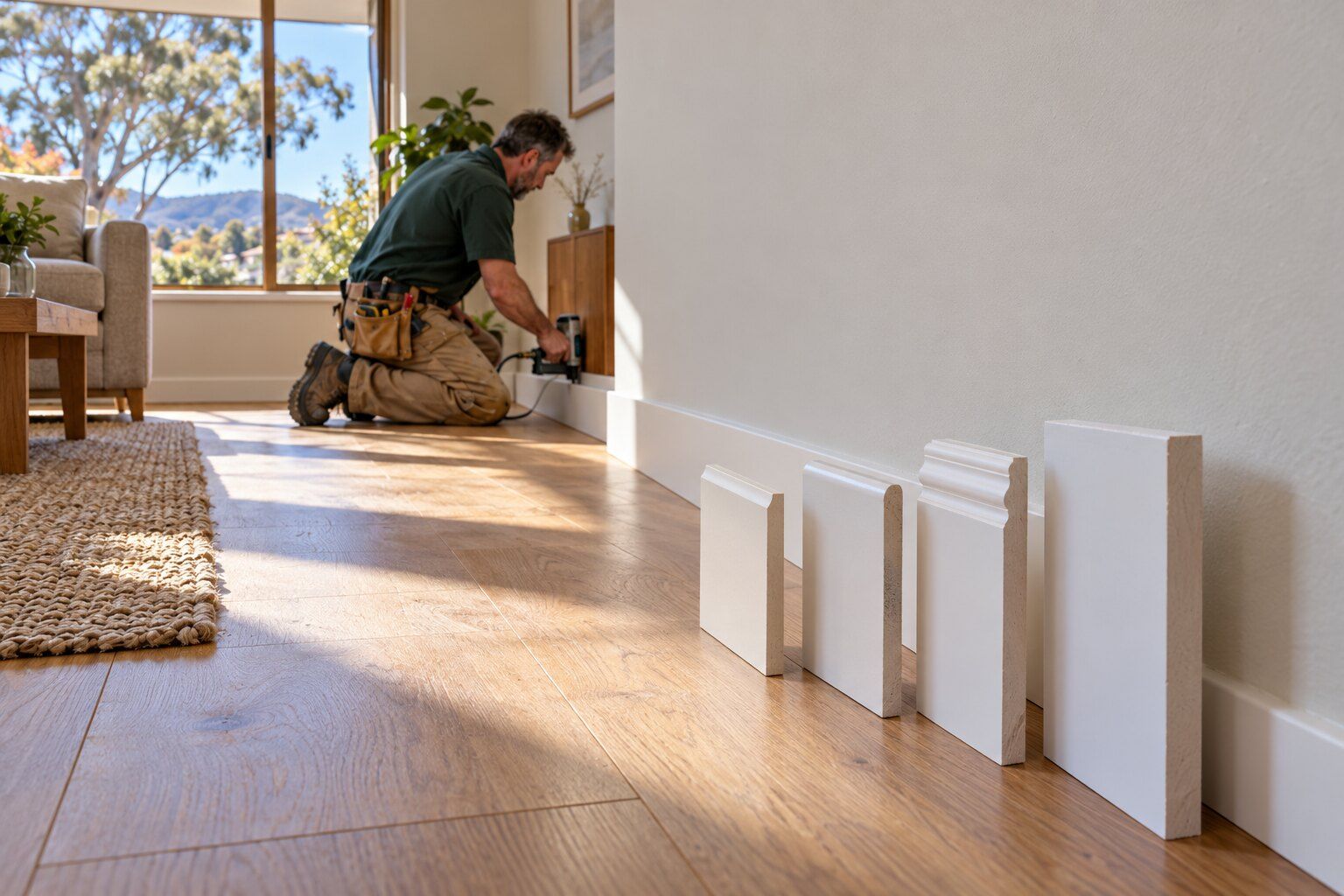
Most skirting comes in a handful of profiles, from plain single bevelled and pencil round to shaped colonial and lambs tongue, in heights such as 67, 92 and 140 mm (Corinthian's primed MDF range, checked 12 October 2026). Simple low profiles suit 1960s to 1980s Canberra homes and modern rooms; taller, shaped profiles suit higher ceilings and period homes. Architraves usually match the skirting profile. Before old trims come off a pre-2003 home, WorkSafe ACT says assume asbestos.
Common skirting board profiles
Profile names vary a little between makers. These are the ones you'll find in most Australian ranges. Corinthian's primed MDF range, for instance, includes:
Single bevelled
A flat board with an angled top edge. Clean and modern, and one of the most widely stocked: Corinthian lists it from 42 × 12 up to 140 × 18.
Pencil round and double pencil round
A flat board with a small rounded top edge (or both edges). Simple, and easy to paint and clean.
Bullnose
A fully rounded top edge, softer than pencil round. Corinthian lists 67 × 18 and 92 × 18.
Half splayed
A sloping face rising to a narrow top. A plain profile that suits simple, older rooms.
Colonial and Australian Colonial
A stepped and curved top edge: the traditional profile in many Australian houses. Corinthian lists colonial up to 140 × 18.
Lambs tongue
A rounded ogee shape on the top edge, more decorative than colonial. Suits higher ceilings.
Square edge (dressed all round)
A plain rectangular board with no profile. The current minimal look, often taller (Corinthian lists 110 and 140 mm), sometimes painted the same colour as the wall.
Choosing a height
Skirting height is mostly about proportion. In a room with a standard 2.4 m ceiling, a 67 mm or 92 mm board looks right; 135 to 140 mm skirting suits higher ceilings and larger rooms, and taller heritage boards (Corinthian's heritage profile is 194 mm) suit period homes with high ceilings.
Taller skirting also hides more of an uneven floor line or old damage at the base of a wall, which is one reason it's popular in renovations. Thickness matters when you're joining new skirting to old architraves: the skirting shouldn't stand proud of the architrave it meets.
Matching skirting to Canberra homes
- 1960s and 1970s brick-veneer homes: low, plain profiles such as half splayed, pencil round or bevelled usually look right and keep the rooms simple.
- 1980s to 2000s project homes: often have colonial or bevelled skirting with matching architraves; replacing with the same profile is easiest when only some rooms change.
- New and renovated homes: square-edge or bevelled boards at 90 to 140 mm, often with a slimmer architrave.
- Heritage precincts: in older areas such as Reid, Braddon and Kingston, matching the original profile matters more; our Inner North and Inner South pages cover the precincts there.
If you're replacing just one room, matching the existing profile is usually better than mixing styles. Many old profiles are still made; where one isn't, a close match in the same height reads well once it's painted.
Architraves: the frame around doors and windows
Architraves are the mouldings around door and window frames. Most makers sell matching pairs: the same profile in a skirting height and an architrave width (often 42 or 67 mm). Using the same profile for both makes a room look finished; a slimmer square-edge architrave with taller skirting is the common modern combination.
New doors are the usual reason architraves change. If you're replacing internal doors, plan the trims with them; see our guide to internal door types.
Replacing skirting boards
Replacing skirting is mostly careful removal. Old boards are usually nailed or glued to the wall, and pulling them off can tear plasterboard paper or crack old render, which then needs patching before the new boards go on. New boards are cut to length, mitred at outside corners and scribed or coped at inside corners so the joint stays tight when the timber moves.
Do it after new floors where you can: skirting sits on the finished floor and covers the expansion gap timber and laminate floors need at the walls. The new boards are then filled, sanded and painted.
Old trims in pre-2003 homes
WorkSafe ACT says any property built before 2003 must be assumed to contain asbestos, and the business doing a refurbishment must have it identified first. Pulling off old skirting can disturb what's behind it. Tell us the year the house was built; see the asbestos guide.
What changes the cost
We don't publish a skirting price: the figures we found were templated or out of date. Skirting is usually priced by the job, and the metres of board, number of corners, removal of old boards, wall repairs and painting are what move it. For published hourly rates, see carpenter rates in Canberra.
Questions about skirting board styles
What is the most popular skirting board style?
Simple profiles such as bevelled, pencil round and square edge are the most common in current renovations, with colonial still found in many existing homes.
What height should skirting boards be?
For a standard 2.4 m ceiling, 67 to 92 mm usually looks right. Taller boards of 135 to 140 mm suit higher ceilings and larger rooms.
Should skirting and architraves match?
Usually, yes. Most profiles are sold in matching skirting and architrave sizes, and matching them makes a room look finished.
Can you replace skirting boards without damaging the wall?
Mostly, with care. Some plasterboard paper or render can come away with old glued boards, and that's patched before the new boards go on.
Do skirting boards go on before or after new floors?
After, in most cases, so the skirting sits on the finished floor and covers the gap at the edge of the flooring.
Where these figures come from
The prices and rules on this page come from these published pages, checked on 8 October 2026 and 12 October 2026.
- Corinthian: mouldings range · Moulding manufacturer's range of skirting and architrave profiles and sizes
- WorkSafe ACT: identify and remove asbestos before residential renovations · WorkSafe ACT safety alert, 16 January 2025