Published · Updated
The short answer
Most squeaks are boards rubbing against each other or moving on loose nails as you walk. Timber Queensland's flooring data sheet says "a small amount of noise can be expected from most timber floors" and that floors are often noisier in drier weather, which is why many Canberra floors creak more in a dry, heated winter. Refixing the loose boards to the joists, usually with screws or new nails, stops most squeaks. Boards that are split, burnt or water-damaged get replaced. A floor that bounces or sags points to the frame below, which is structural (checked 12 October 2026).
Why floorboards squeak
Tongue-and-groove floorboards are nailed to joists, and they move slightly with every step. Squeaks come from that movement:
- Boards rubbing on each other along the tongue and groove, or at the ends
- Loose nails sliding up and down in their holes as a board flexes
- A gap between board and joist, often where a joist has shrunk or twisted, so the board bends before it meets support
- Joists or bearers rubbing on each other or on packing over the piers
The noise itself rarely means anything is about to fail. It's the floor telling you something is moving that shouldn't be.
Why Canberra floors creak more in winter
Timber takes up and gives off moisture with the air around it. Canberra winters are cold and many homes run heating for months, which dries the air and the floor. Timber Queensland's data sheet on acceptable timber floors, prepared with the Australian Timber Flooring Association, says "a floor is often more noisy during drier weather due to loosening at the joints", and that in drier times of year shrinkage gaps between boards "may average 0.75 mm for boards of a cover width of 80 mm".
So a floor that's quiet in autumn can tick and creak in July and settle again in spring. That seasonal noise is normal. A squeak in one spot that's there all year, or one that's getting worse, is worth fixing.
Fixes that work
Refix the boards to the joists
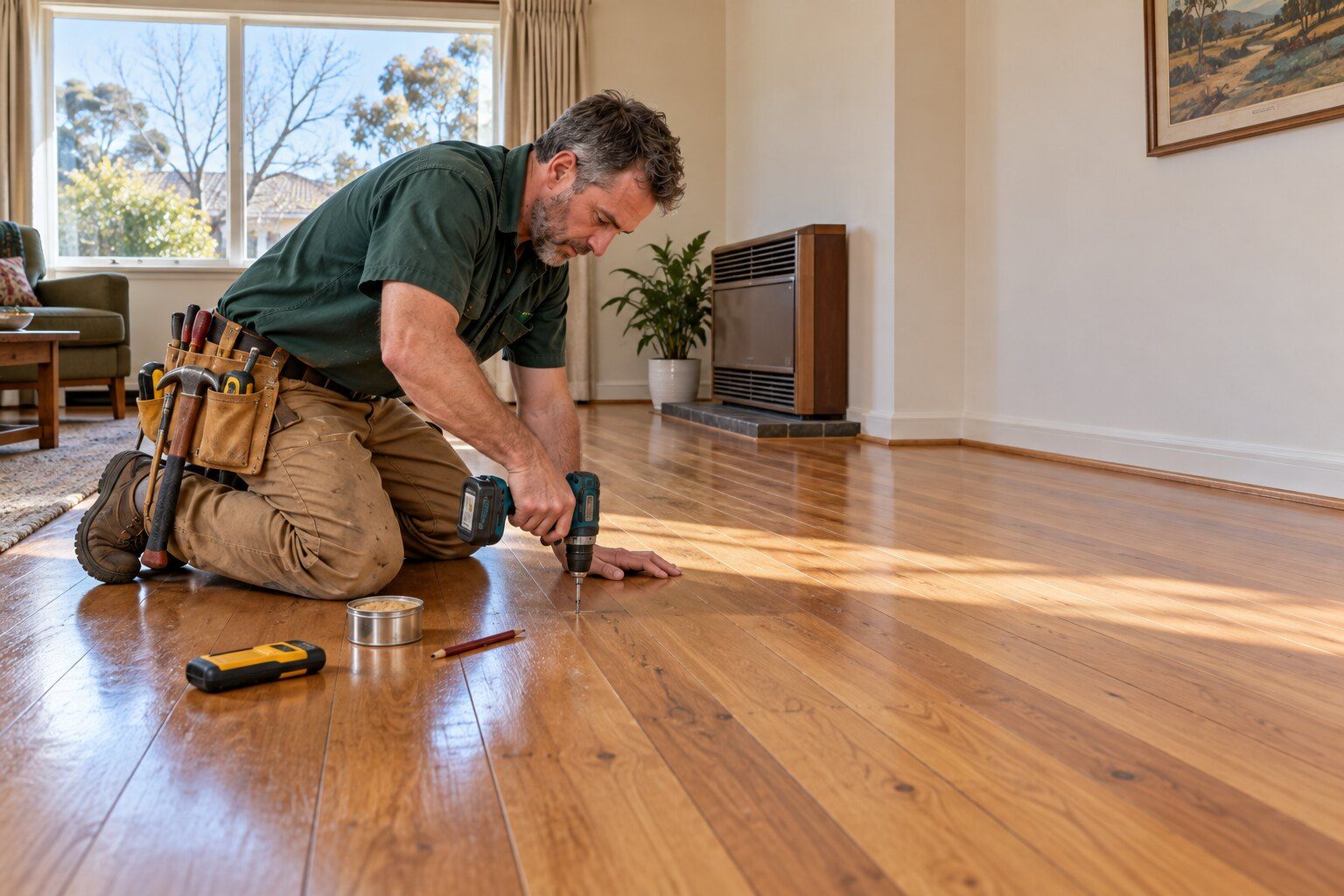
The most common fix. Find the joist under the squeak, then fix the board down with a screw or new nail, punched below the surface and filled. On a polished floor the fill is matched to the timber colour.
Fix from underneath
Where there's access under a suspended timber floor, a squeak can be fixed from below by screwing up through a block, or packing a gap between joist and board, which leaves the top of the floor untouched.
Lubricate the joint
For boards rubbing along a joint, a dry lubricant such as talc worked into the gap can quieten them for a while. It's a short-term fix.
Replace the board
A split, cupped, burnt or soft board that keeps moving is best cut out and replaced with matching timber.
Floorboard replacement
Replacing a few boards in an old floor means cutting out the damaged ones without damaging their neighbours, then fitting new boards of the same width, thickness and species. The last board in a repair is usually fitted by removing the bottom lip of its groove so it can drop into place, then fixed down.
Matching matters most on polished floors. Older Canberra floors are often hardwood, and new boards of the same species will look lighter until the floor is sanded and recoated. For a few boards, a careful colour match is usually enough; for a large patch, sanding the whole room evens it out. Our floorboard repairs page covers the patching work we do, including where walls and heaters have come out.
When it's not the boards: bounce, sag and slope
A squeak is a board problem. A floor that bounces, sags in the middle of a room, or slopes towards one wall is usually a frame problem: undersized or damaged joists, bearers that have sagged, piers that have sunk, or termite or rot damage underneath.
Look underneath if you can do it safely, or have someone check. Termite damage needs a pest inspection before any repairs; see our guide to termite damage.
Frame repairs need a licensed builder
Replacing or strengthening joists, bearers or piers, and restumping, are structural repairs that need a licensed ACT builder. Board repairs on a sound frame are carpentry we do.
Under the floor in older homes
WorkSafe ACT says any property built before 2003 must be assumed to contain asbestos, and some older homes have fibre-cement sheeting under floor coverings or around the subfloor. Homes on the loose-fill asbestos register have extra rules for work that may disturb the subfloor. Tell us the year the house was built; see the asbestos guide.
Questions about squeaky floorboards
Are squeaky floorboards a sign of a structural problem?
Usually not. Squeaks are normally boards rubbing or moving on loose fixings. A floor that bounces, sags or slopes is more likely to have a problem in the frame below.
Why do my floorboards squeak more in winter?
Dry air from heating shrinks timber slightly and loosens the joints. Timber Queensland's flooring data sheet notes floors are often noisier in drier weather.
Can squeaky floorboards be fixed without lifting them?
Yes, most can. Boards are refixed to the joists from above with screws or nails that are punched and filled, or from underneath where there's access.
Can you replace just one or two floorboards?
Yes. Damaged boards are cut out and new boards of the same width, thickness and timber are fitted. New boards look lighter until the floor is recoated.
Are gaps between my floorboards normal?
Some seasonal gapping is. Timber Queensland's data sheet says gaps may average 0.75 mm for 80 mm boards in drier times of year. Wide or growing gaps are worth a look.
Where these figures come from
The prices and rules on this page come from these published pages, checked on 12 October 2026.
- Timber Queensland Technical Data Sheet 31: acceptable appearance from timber floors · Industry data sheet prepared with the Australian Timber Flooring Association, revised March 2014 (copy hosted by a timber supplier)
- WorkSafe ACT: identify and remove asbestos before residential renovations · WorkSafe ACT safety alert, 16 January 2025
- ACT Government: Affected Residential Premises Register · Loose-fill asbestos register, updated quarterly (as at 30 June 2026)
- ACT Planning: builder licence · Territory Planning Authority, ACT builder licence classes