Published · Updated
The short answer
Hollow-core doors are light and cheap; solid-core doors are about twice the weight and a little quieter: Hume's brochure rates its hollow-core doors at Rw 25 to 27 and its solid-core doors at Rw 29 to 30. Most internal doors are 2040 mm high and 35 mm thick. A cavity slider disappears into the wall but means opening the wall up; a barn door slides on a track outside the wall and needs solid fixing above the opening. A national guide puts an internal sliding door at $300 to $600 for labour (checked 8 October 2026).
Hollow-core vs solid-core doors
A hollow-core door has thin skins over a honeycomb or cardboard core with a timber frame around the edge. A solid-core door is filled with particleboard or MDF. In Hume's internal doors brochure (July 2022), hollow-core ranges weigh about 14 to 18 kg and the solid-core ranges about 30 kg.
The extra mass is what makes a solid core quieter. Hume rates its hollow-core doors at Rw/STC 25 to 27 and its solid and particleboard-core doors at 29 to 30. That's a noticeable step for a bedroom, study or bathroom, but no internal door is soundproof: gaps under and around the door let most sound through, so seals matter as much as the core.
Hollow core suits
Wardrobes, linen cupboards, laundries and rooms where cost matters more than quiet. Easy to hang on old hinges.
Solid core suits
Bedrooms, studies, bathrooms and toilets, the door between the living area and a hallway, and anywhere you want a heavier feel. Needs three good hinges and a frame that's square and firm.
Standard internal door sizes
Hume's brochure lists most internal doors at 2040 mm or 2340 mm high and 35 mm thick, in widths of 520, 620, 720, 770 and 820 mm. Older Canberra homes almost always take 2040 mm doors. Measure the existing door rather than the frame, and check whether the frame is still square: in many 1960s and 1970s homes the frames have moved a little, so a new door is trimmed to fit rather than dropped straight in.
Cavity sliding doors
A cavity slider runs on a track inside a pocket in the wall, so the door disappears when it's open. It saves the floor space a hinged door swings through, which is why they're popular for ensuites, laundries and tight hallways.
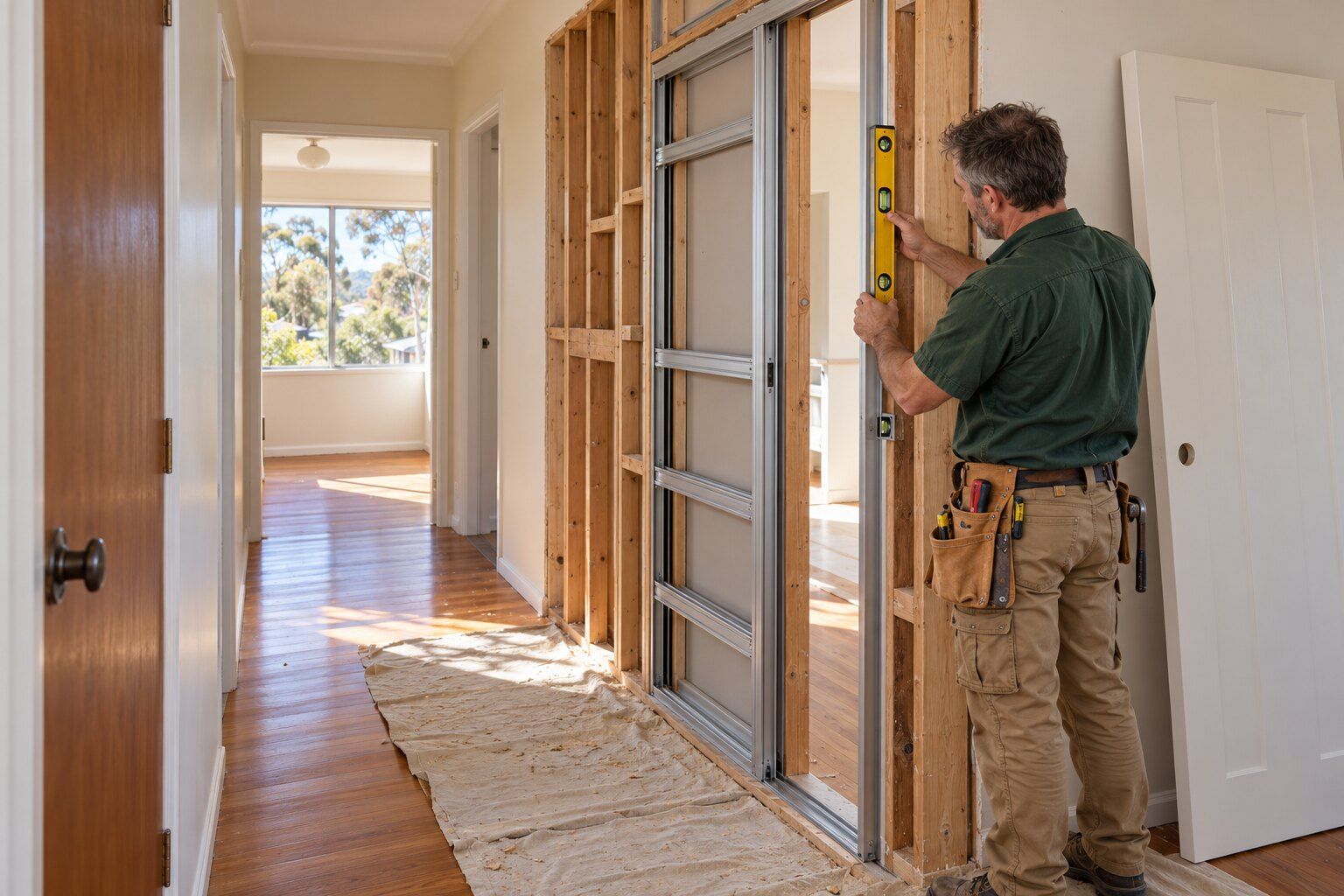
The catch is the wall. The door needs a pocket roughly as wide as the door beside the opening, built from a cavity slider frame. CS for Doors says its SlimSlider units suit 70 mm framework and its standard units suit 90 mm framework, and recommends 35 to 38 mm thick doors for most of its systems. Fitting one into an existing wall means taking the plasterboard off that section, removing studs, fitting the frame and relining.
- Light switches, power points, pipes or ducts in that part of the wall have to move first, and electrical work needs a licensed electrician
- A load-bearing wall changes the job: the opening needs a lintel designed for the load, which is structural work for a licensed builder
- A new opening wider than 2 m needs a licensed ACT builder
Barn doors
A barn door hangs from a track fixed to the wall above the opening and slides across the face of the wall. It suits places where you can't open the wall for a cavity slider, and it's a feature in its own right.
Things to plan for: the wall beside the opening needs to be clear of switches, art and furniture for the full width of the door; the track needs solid fixing into the framing, not just into plasterboard; and because the door sits off the wall, it doesn't seal well, so it's not the right choice for a bathroom where privacy and sound matter.
What each type costs to install
We couldn't find a Canberra business that publishes per-door prices. A national jobs marketplace publishes these ranges, which we quote as published:
Internal door prices by type
| Door type | Price | Source |
|---|---|---|
| Internal hollow-core door, labour only | $150 – $280 | Mates Rates (national) |
| Internal hollow-core door, supply and install | $250 – $450 | Mates Rates (national) |
| Internal solid-core door, labour only | $200 – $350 | Mates Rates (national) |
| Internal solid-core door, supply and install | $400 – $800 | Mates Rates (national) |
| Internal sliding door (pocket or barn), labour only | $300 – $600 | Mates Rates (national) |
From a national jobs marketplace's 2026 price guide, last reviewed June 2026, checked 8 October 2026. It says the figures are "informed by real carpentry and handyman jobs posted" on its marketplace, "cross-checked against current published tradie rate cards", and doesn't say whether GST is included. Its typical quote includes removing the old door, hanging and trimming the new one and fitting the handle; the door itself, a new frame and painting usually aren't. We couldn't find a Canberra business that publishes per-door prices.
Cutting a new cavity, moving services and relining aren't in a door-swap price. The door installation cost guide lists every door type, including front doors and bifolds.
Changing doors in an older Canberra home
WorkSafe ACT says homes built before 2003 must be assumed to contain asbestos. Swapping a door in its existing frame doesn't disturb the wall, but replacing a frame, cutting a cavity or removing a wall lining can. Tell us the year the house was built; see the asbestos guide.
If you rent, changing doors is an alteration that needs the lessor's written consent. Landlords and property managers can arrange door work through our doors page.
Questions about internal door types
Are solid-core doors worth it?
For bedrooms, studies and bathrooms, often yes: they're heavier and Hume rates them a few points quieter (Rw 29 to 30 against 25 to 27 for hollow core). For cupboards and laundries, hollow core is usually enough.
What size is a standard internal door in Australia?
Most are 2040 mm high and 35 mm thick, in widths of 520 to 820 mm, according to Hume's brochure. Measure your existing door before buying.
Can a cavity sliding door go into an existing wall?
Usually, if the wall isn't load-bearing and the section beside the opening is clear of services. The plasterboard comes off, a cavity frame goes in and the wall is relined.
Do barn doors block sound?
Not well. They hang off the face of the wall with gaps around them, so they're better for a pantry or study than a bathroom.
Can I put a solid-core door in my old frame?
Often, if the frame is firm and square. A solid-core door is about twice the weight of a hollow one, so it needs three good hinges fixed into solid timber.
Where these figures come from
The prices and rules on this page come from these published pages, checked on 8 October 2026 and 12 October 2026.
- Hume Doors: internal doors brochure (July 2022) · Door manufacturer's brochure (sizes, cores, weights, Rw/STC sound ratings), hosted by a building supplier
- CS for Doors (Cavity Sliders): FAQ · Cavity sliding door frame manufacturer's FAQ (framework widths, door thickness)
- Mates Rates: door installation cost in Australia (2026 price guide) · National jobs marketplace cost guide with a Canberra row, last reviewed June 2026
- ACT Planning: check if you need a building approval · Territory Planning Authority guide to exempt building work
- WorkSafe ACT: identify and remove asbestos before residential renovations · WorkSafe ACT safety alert, 16 January 2025