
Published
The short answer
The standard Australian internal door is 2040 mm high and 35 mm thick. Hume's internal doors brochure (July 2022) lists standard widths of 520, 620, 720, 770 and 820 mm, and a taller 2340 mm height in the same widths. Doors Plus, a door retailer, says the most common internal door in Australian homes is 820 mm wide by 2040 mm high, and also stocks 870 and 920 mm widths (checked 5 November 2026).
Standard internal door sizes
Internal door sizes by type
| Door | Size (mm) | Source |
|---|---|---|
| Hinged internal door, standard height | 2040 × 520, 620, 720, 770 or 820 × 35 | Hume brochure (manufacturer) |
| Hinged internal door, tall | 2340 × 520, 620, 720, 770 or 820 × 35 | Hume brochure (manufacturer) |
| Custom-size internal door (limits vary by range) | from 1990 × 400 up to 2400 × 1200 × 35 | Hume brochure (manufacturer) |
| Flush internal door | 2040 or 2340 × 520 to 920 | Doors Plus (retailer) |
| Pocket (cavity sliding) door | 2040 × 720, 770, 820 or 870 | Doors Plus (retailer) |
| Bifold door | 2040, or 2340 in some ranges, × 620 to 920 | Doors Plus (retailer) |
| Sliding door | 2040, 2120 or 2340 × 620 to 920 | Doors Plus (retailer) |
Sizes in millimetres, height × width × thickness where given. Hume's internal doors brochure is dated July 2022 and lists every door at 35 mm thick; Doors Plus, a door retailer with a Fyshwick showroom, lists widths of 520, 620, 720, 770, 820, 870 and 920 mm for flush doors and doesn't give thicknesses. Checked 5 November 2026.
A 2340 mm door suits homes with higher ceilings, but it needs a taller frame, so it isn't a straight swap for a 2040 mm door.
Door widths in new homes: the 820 mm clear opening
The national Livable Housing Design Standard says at least one entrance door to a home must have a clear opening of at least 820 mm, and so must internal doorways on the entry level to habitable rooms, the laundry, a toilet or bathroom, and an attached garage. The clear opening is the gap the door leaves when open, not the door's width. The Standard notes that an 820 mm clear opening for a single swinging door can generally be achieved with an 870 mm door leaf.
In the ACT, the Housing Industry Association reports that these livable housing rules apply to new homes approved from 15 January 2024. Renovations are handled differently, so check with a building certifier before planning a new opening around them. Replacing a door in an existing opening is ordinary carpentry.
Toilet doors: opening outwards, sliding or lift-off hinges
The National Construction Code (NCC 2022, Housing Provisions 10.4.2) says the door to a fully enclosed toilet must open outwards, slide, or be removable from outside, unless there is a clear space of at least 1.2 m between the toilet pan and the doorway. The reason is to reach someone who has collapsed against the door. That's why small toilets often have a sliding door or lift-off hinges.
NCC 2025 started in the ACT on 1 May 2026 and becomes mandatory on 1 May 2027, according to ACT Planning.
Cavity sliding door sizes
CS for Doors (Cavity Sliders) stocks cavity frames made to suit standard door sizes such as 2040 × 820 mm, and recommends 35 to 38 mm thick doors for most of its systems. Doors Plus lists pocket doors at 2040 mm high in 720, 770, 820 and 870 mm widths. What a cavity frame needs inside the wall is in our guide to internal door types.
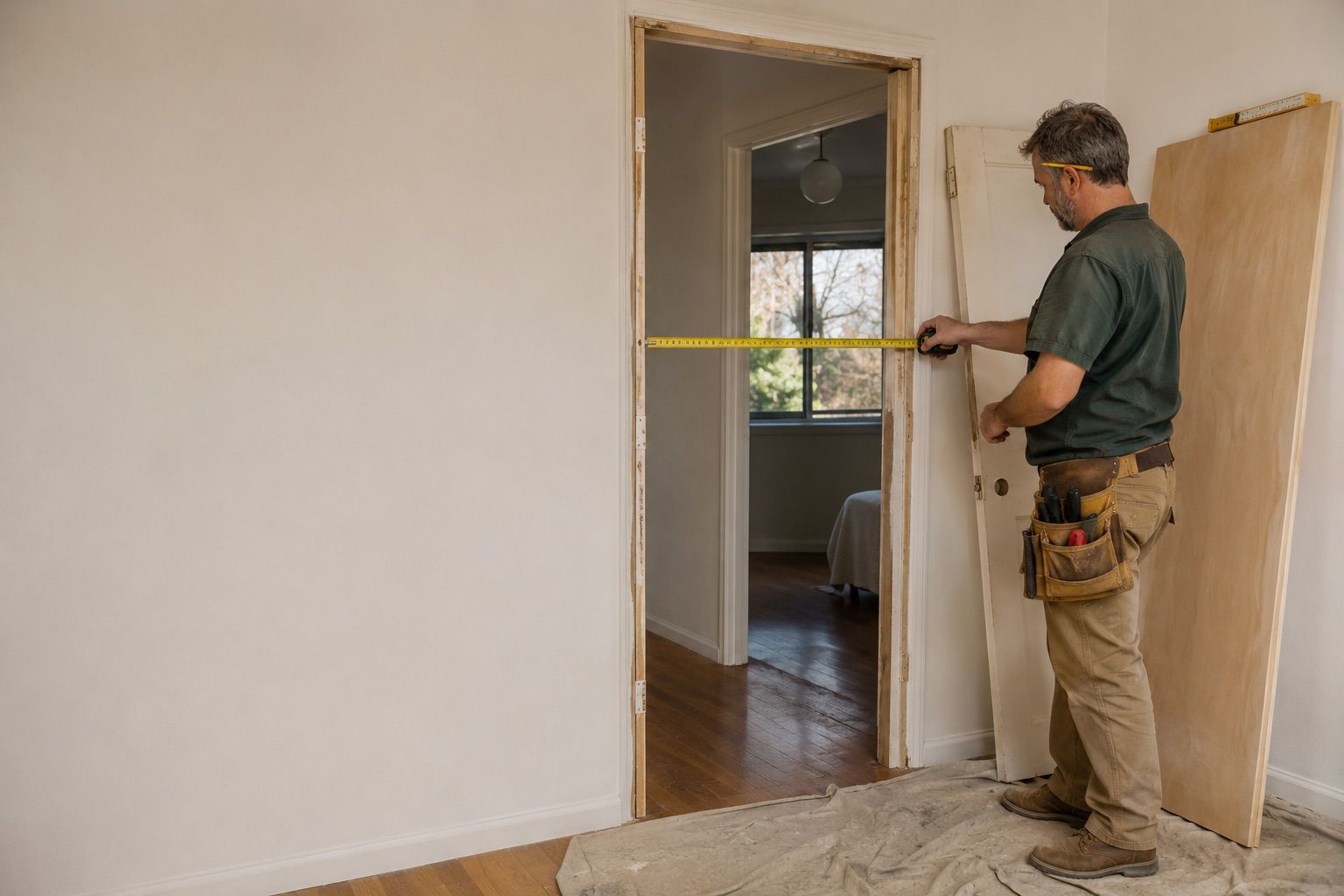
How to measure a door opening
Corinthian Doors, a door manufacturer, sets out these steps:
- Measure the width between the jambs at the top, middle and bottom
- Measure the height from the threshold to the top of the frame on both sides
- Check the depth of the frame
- Measure the opening diagonally, corner to corner both ways, to see whether it's square
Corinthian allows about 3 mm between the door and the frame at the top and sides, and about 5 mm at the bottom above the floor covering. Older Canberra homes often have openings that have moved out of square or don't match a standard size, so measure before ordering, or have us measure.
Questions about door sizes
What is the standard door height in Australia?
2040 mm. Hume and Doors Plus both list 2040 mm as the standard internal door height, with 2340 mm doors for taller openings.
What is the standard door width in Australia?
Doors Plus says the most common internal door is 820 mm wide. Hume's standard widths run from 520 to 820 mm, and Doors Plus also stocks 870 and 920 mm doors.
How thick is a standard internal door?
35 mm. Every door in Hume's internal doors brochure is 35 mm thick, and Cavity Sliders recommends 35 to 38 mm doors for most of its cavity frames.
Do I have to fit an 870 mm door?
Usually not. The Housing Industry Association reports that the 820 mm clear-opening rule in the Livable Housing Design Standard applies to new ACT homes approved from 15 January 2024, and only to certain entry-level doorways. The Standard notes an 870 mm door can generally achieve it. If you're changing an opening, check with a building certifier.
Can you cut a standard door down to fit?
A little can come off the edges to fit a frame that has moved, which is a normal part of hanging a door. Openings well off standard sizes are better suited to a custom-size door; Hume makes internal doors from 1990 × 400 mm up to 2400 × 1200 mm, depending on the range.
Where these figures come from
The prices and rules on this page come from these published pages, checked on 5 November 2026.
- Hume Doors: internal doors brochure (July 2022) · Door manufacturer's brochure (sizes, cores, weights, Rw/STC sound ratings), hosted by a building supplier
- Doors Plus: standard internal door sizes in Australia · Door retailer with a Fyshwick showroom, undated size guide
- CS for Doors (Cavity Sliders): FAQ · Cavity sliding door frame manufacturer's FAQ (framework widths, door thickness)
- Corinthian Doors: how to buy Corinthian doors (measuring) · Door manufacturer's measuring and clearance guidance
- ABCB Livable Housing Design Standard 2022 (version 1.3) · Australian Building Codes Board standard, 15 November 2023 (clauses 2.1 and 3.1, door clear openings)
- HIA: delayed NCC 2022 adoption in the ACT · Housing Industry Association, 19 December 2023 (livable housing applies to new ACT approvals from 15 January 2024)
- NCC 2022 Housing Provisions, part 10.4: facilities · Australian Building Codes Board, clause 10.4.2 (doors to enclosed toilets)
- ACT Planning: National Construction Code · Territory Planning Authority, NCC 2025 commencement in the ACT